
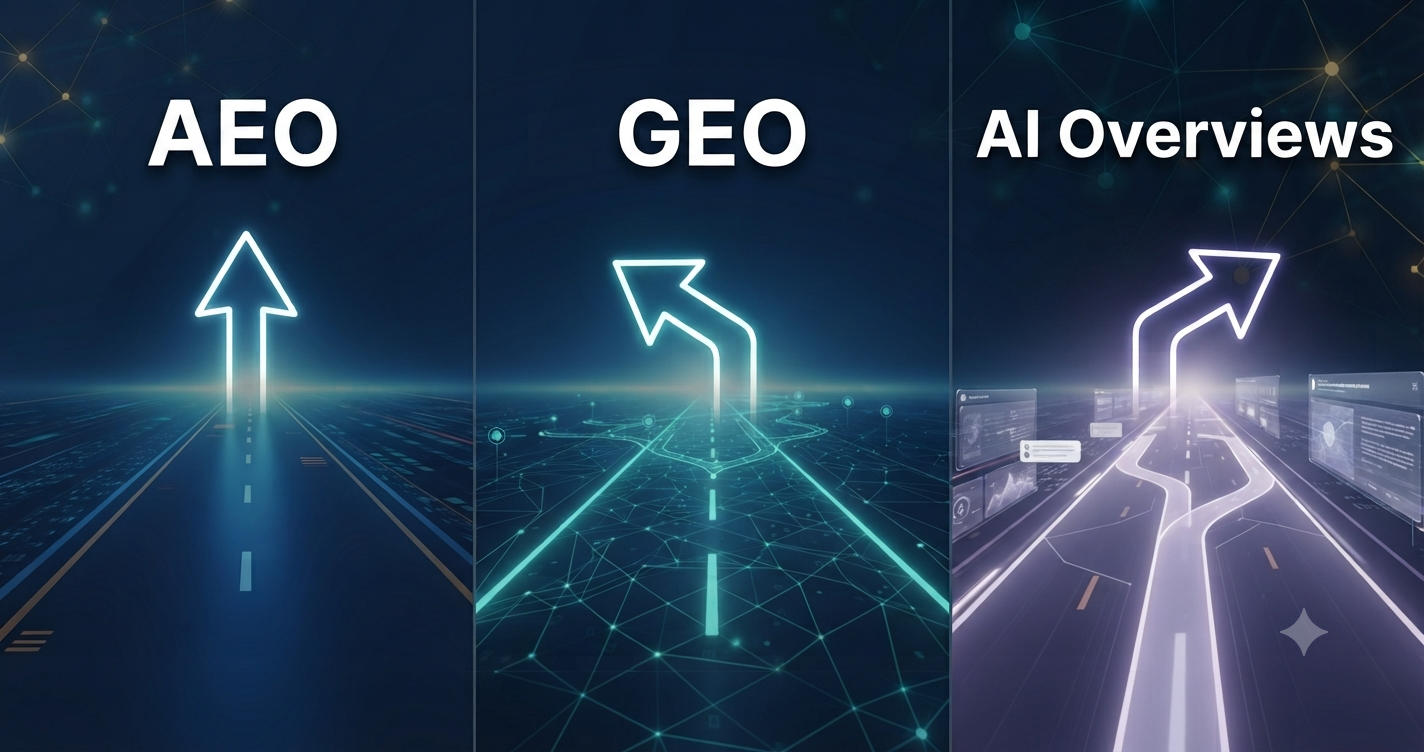
Ask ten marketers what to call the new way of showing up in AI, and you'll get ten answers. GEO. AEO. AI Overviews. AISEO. LLMO. ASO. The acronyms are multiplying faster than anyone can keep track.
The data backs up the chaos. In a 2025 study that analyzed thousands of LinkedIn and Reddit posts, 84% of marketers recognized "GEO," 61% recognized "AEO," and the industry still couldn't agree on a single name. Search interest in these terms is up triple digits in a single quarter, and yet nobody has planted a flag everyone salutes.
Here's what most of the noise misses: the acronyms are different roads. The destination is the same city.
Let me give you the plain-English version, and then the part that actually matters for your brand.
The three roads: AEO vs GEO vs AI Overviews
AEO, Answer Engine Optimization
Answer Engine Optimization (AEO) is about being the answer. When someone asks an answer engine, ChatGPT, Perplexity, Google's answer box, a voice assistant, a direct question, AEO is the work of making sure your brand is what gets surfaced. It lives at the answer layer: the moment the machine decides what to say back.
GEO, Generative Engine Optimization
Generative Engine Optimization (GEO) is the broader umbrella: being cited, mentioned, or recommended inside the output of generative AI models. If AEO is about being the answer, GEO is about being in the mix wherever an LLM generates a response, across ChatGPT, Gemini, Claude, Perplexity and the rest. It's the term most of the industry has drifted toward as the catch-all.
AI Overviews
AI Overviews isn't a strategy. It's a place. AI Overviews is Google's AI-generated summary that now sits at the very top of many search results (what used to be called SGE). It's a specific surface, owned by Google, where an AI answer appears above the traditional blue links, Search plus Gemini, working together.
And then there's the long tail, AISEO, LLMO, AISO, ASO, which are, for practical purposes, the same idea wearing different jackets.
🔎 Prompts to try right now (see where your brand stands)
Run these in ChatGPT, Perplexity and Google. If your brand isn't named, that's your AI-visibility gap, and it's fixable.
Why all roads lead to Rome
Here's what nobody arguing about the name will tell you: whichever acronym you pick, the underlying work is nearly identical.
To show up as the answer in ChatGPT (AEO), to get cited across generative models (GEO), or to appear in Google's AI Overviews, an AI engine has to do the same four things about you:
- Understand who you area clear, machine-readable identity (entity clarity, structured data, schema).
- Trust youauthoritative, consistent information about you across the web, not just on your own site.
- Find you citablecontent that directly answers the questions people actually ask.
- Keep seeing youconsistency and recency across every place it can read you.
Get those four right, and you don't have to bet on which acronym wins. You show up across all the surfaces, because they all draw from the same well. That's Rome. The roads are just the marketing.
So the honest advice is: stop optimizing for an acronym. Optimize to be the answer.
What this means for your firm
Now make it concrete. A prospect breaks their wrist in a car accident. Ten years ago they Googled "personal injury lawyer near me" and scrolled. Today, a growing number of them open ChatGPT or Perplexity, or just read Google's AI Overview, and ask, "Who's a good personal injury lawyer in my city, and how do contingency fees work?"
In that moment, one question decides everything: does the AI name your firm, or someone else's?
Notice the client didn't care whether the answer came via "AEO," "GEO" or "AI Overviews." They asked a question and got a short list of names. You were on it, or you weren't. All three roads led them to the same place, an answer, and your job is to be in that answer, wherever it's generated.
That's the quiet good news for law firms: you don't need a different strategy for each acronym. You need one strategy, clear identity, trusted and consistent information, answer-ready content, everywhere AI can read you, and it works across every surface at once.
What actually matters: it's all embeddings
Here's the deeper truth, and it's where we plant our flag.
At FirePencil.AI, AI search is the only thing we work on. After extensive research across engines, we keep arriving at the same conclusion: to a large language model, it's all the same.
When someone asks ChatGPT (AEO), reads a generative answer (GEO), or sees Google's AI Overview (Search + Gemini), the model isn't thinking about which "channel" they came through. Underneath, it's doing one thing: turning the question into embeddingsmathematical representations of meaning, and retrieving the most relevant, most connected entities from its knowledge graph (what the field calls graph RAG). The LLM doesn't know or care whether it's an "answer engine," a "generative engine" or an "AI Overview." It cares about what your brand means in vector space, and how well-connected it is in the graph.
So technically: AEO = GEO = AI Overview. Different labels, one underlying machine.
Which is why chasing acronyms is a waste of energy. The real work is making your brand legible to the model itselfa clear entity, richly and consistently connected to the facts, topics and citations that define you, so that whatever the surface, the embedding lands on you. Do that, and you're not optimizing for one road. You're optimizing for Rome.
The takeaway
AEO, GEO, AI Overviews, different roads, same city, and underneath, the same machine. Don't get lost debating the map. Make your brand unmistakable to the model, clear entity, strong connections, consistent facts, and you become the name the answer returns, everywhere.
Rome was worth reaching no matter which road you took. So is this.