
Introduction
Your next client may never Google you. In 2025, 28% of consumers said they would use ChatGPT to research a lawyer, up from just 9% in 2023.1 Nearly 78% of legal search queries now trigger a Google AI Overview,2 and about 58% of US searches end without a single click.3 The front door to legal services is no longer a results page. It is an AI answer, and researchers now describe it exactly that way.7
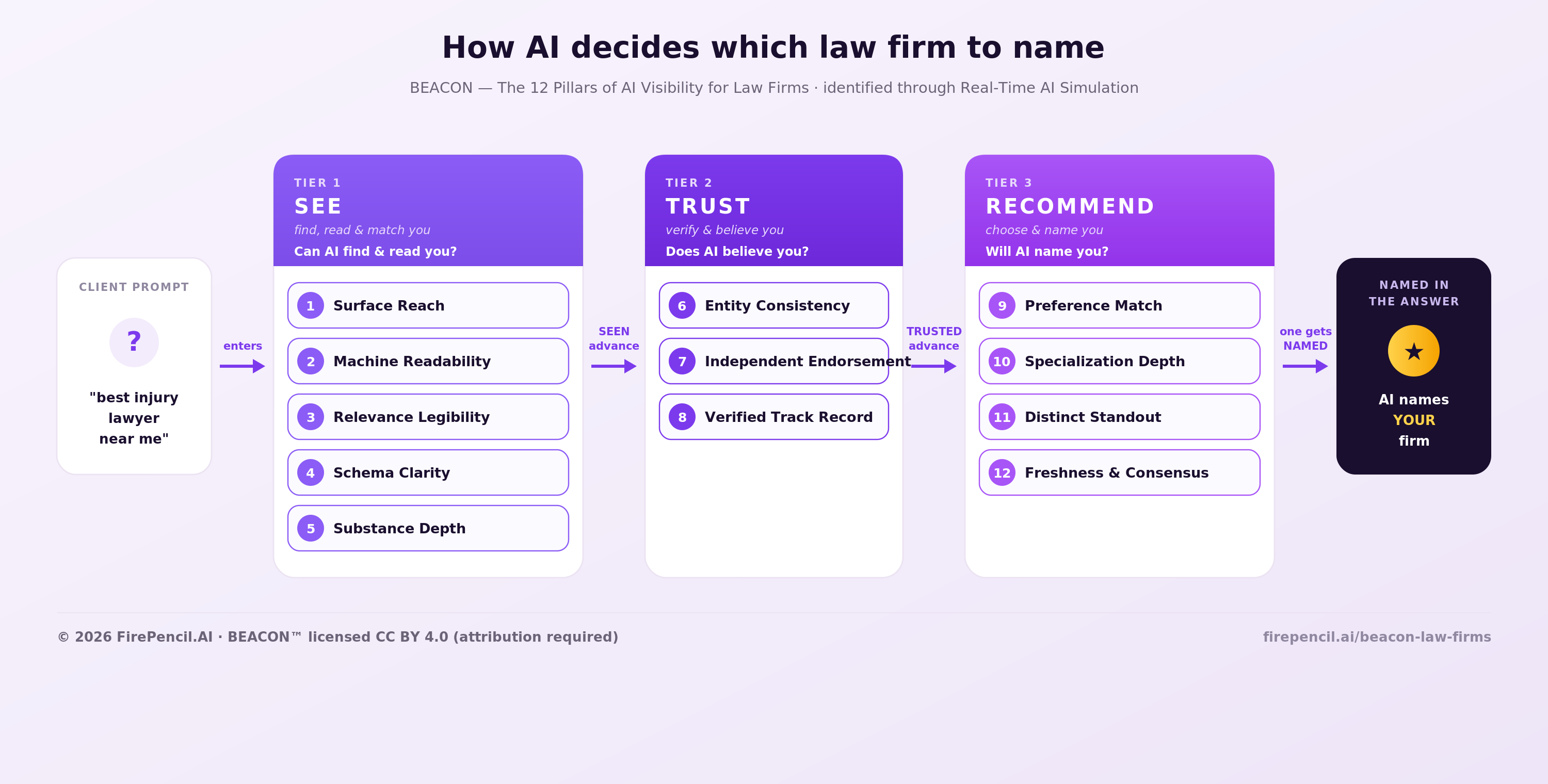
The consequence is already in the data: the median law firm's website traffic fell roughly 19% last year.4 BEACONBrand Engagement for Agent-Citation Observable Networks, is FirePencil.AI's framework for explaining and measuring how that answer is decided, and how a firm becomes the one that gets named. It defines the 12 pillars an AI reads, grouped into three tiers, SEE → TRUST → RECOMMEND.
You can rank #1 on Google and still be invisible
Google ranks pages. An answer engine does not rank. It resolves and selects. When a prospective client asks, "Who's the best injury lawyer in Tampa?", the model does not return ten blue links. It reconstructs a single entity for each candidate firm, judges those entities against one another, and names two or three. Your PPC spend, your years of legal SEO, your page-one ranking for "Tampa personal injury attorney" none of it guarantees a seat in that answer. The engine is evaluating your firm on a broader, entity-level set of signals, and most firms have been built for none of them.
So what is AEO, and why isn't it just SEO?
AEO stands for Answer Engine Optimization: engineering your firm to be named inside the AI's answer, not merely ranked in a list of links a human has to click. The difference from SEO is not cosmetic. It is a different unit of optimization:
- SEO optimizes pages. AEO optimizes your firm as an entity the model can resolve, trust, and prefer.
- SEO rewards keywords and backlinks. AEO rewards entity clarity, structured data, cross-source consistency, and earned citations across the entire web.
- SEO gets you found. AEO gets you named.
Our view, and we'll be direct about it
AEO, GEO, "AI SEO," AI Overview optimization, the industry sells these as separate disciplines. Technically, they are one problem. Every answer engine is a generative engine, and every generative engine is an answer engine. Google's "AI Mode" is simply Search fused with Gemini, classic ranking still counts, for now, but the surface is moving fully to AI. Optimize for how a model resolves and selects an entity, and you optimize across all of them at once.
The engines that now decide who gets the call
When a prospective client asks for a lawyer, one of these engines composes the answer, and each weights the signals differently. Perplexity and AI Overviews lean hard on earned citations; ChatGPT and Gemini weigh your owned entity and structured data. To be the firm that gets named, you have to be legible to all of them at once.
Why legal marketing is different
Legal marketing is not like marketing a product or a general service, and that difference is exactly why AI treats legal search so cautiously.
- It is regulated. Lawyer advertising is governed by professional-conduct rules that forbid false or misleading claims and restrict solicitation, the ABA Model Rules 7.1–7.3, adopted in some form by every US state.R2
- It is high-stakes and trust-driven. Choosing the wrong lawyer can cost a person their money, freedom or family, so buyers, and the engines that serve them, weight credibility far more heavily than in ordinary commerce.
- It is jurisdiction-bound. Law is local: a "best custody lawyer" is meaningless without the state and city, because a lawyer must be licensed in the relevant jurisdiction.
- Claims must be verifiable. Endorsements and testimonials are governed by the FTC's rules on truthful, substantiated endorsements.R3
US legal-marketing law & regulation (in brief)
- Bates v. State Bar of Arizona, 433 U.S. 350 (1977). Lawyer advertising is commercial speech protected by the First Amendment, but states may still ban false, deceptive or misleading advertising.R1
- ABA Model Rules 7.1–7.3 (amended 6 Aug 2018). Rule 7.1 bars false or misleading communications; 7.2 governs advertising and paying for referrals; 7.3 defines and limits solicitation. States adopt their own versions, so rules vary.R2
- FTC Guides on Endorsements & Testimonials, 16 C.F.R. Part 255. Client testimonials and reviews used in marketing must be truthful and substantiated.R3
This summarises general rules and is not legal advice; firms should confirm their own state bar's rules.
How BEACON was identified, Real-Time AI Simulation
BEACON was not derived from opinion or from SEO tactics relabelled for AI. FirePencil identified it empirically, through real-time AI simulation: putting real legal buyer prompts to live answer engines, observing which firms they name and which they drop, and reconstructing, step by step, what a firm had to establish before it was named. Aggregated across the corpus, the decisive factors converge on twelve pillars, each operating at one of three tiers.
The three tiers, and why AI must move through them for legal search
Tier 1 SEE, can AI find, read and match your firm?
- The legal web is enormous and directory-dominated (Avvo, Justia, FindLaw, Super Lawyers). If an engine cannot cleanly identify an individual firm, it names a directory instead.
- Legal queries are jurisdiction- and specialty-boundan engine must confirm both practice area and location, or the firm is filtered out before it is a candidate.
- Many firm sites are technically hard to read (JavaScript-heavy, thin, poorly structured). Structured, schema-rich content can lift AI visibility by up to 115%5but SEE is the floor, not the finish line.
Tier 2 TRUST, does AI believe your firm?
- Legal is the archetypal high-stakes ("YMYL") domain. Naming the wrong or unlicensed lawyer can cause real harm, so engines drop entities they cannot corroborate.
- Legal advertising is regulated (Rules 7.1–7.3): engines favour independently verifiable claims over self-asserted superlatives.R2
- The cost of naming an untrustworthy legal provider is uniquely high, so the engine requires corroboration, consistent identity, independent endorsement, verifiable track record, before advancing a firm.
Tier 3 RECOMMEND, will AI name your firm?
- Legal intent is exceptionally specificthe right answer is the most precisely fitting trusted firm, not the biggest.
- Specialisation beats generalitya firm concentrated on the exact matter type is preferred over a general practice.
- The engine needs a stateable reason to name youa verifiable differentiator, and favours firms whose signals are current and agreed across sources.
The 12 Pillars
The 12 pillars are the signals an AI answer engine reads when it decides whether to name your firm. They divide across the three tiers, five for SEE, three for TRUST, and four for RECOMMENDand together they are what the FirePencil agent measures as your BEACON Score.
Present and retrievable across the sources engines draw on, your site, maps, reputable directories and mentions.
Clean, server-rendered, well-structured pages an engine can parse without ambiguity.
Unmistakable match between your content and the practice area + jurisdiction asked about.
Accurate structured data (Attorney/LegalService, location, practice areas) telling the engine what and where you are.
Pages that genuinely answer the legal question, not thin service stubs.
Name, address and bar/registration identifiers resolve consistently everywhere the engine looks.
Third-party client reviews, ratings, citations and mentions you do not control.
Checkable credentials: bar standing, verdicts/settlements, awards, years in practice.
Fit to the prompt's exact qualifiers: jurisdiction, practice area, case type, fee model, language.
Concentrated authority on the specific matter type, not generalist breadth.
A clear, nameable differentiator the engine can state in one line.
Recent signals, agreed across independent sources.
The BEACON Score
The BEACON Score is an AEO audit of a law firm across the 12 pillars, expressed 0–100. Each pillar is scored 0–100; the tiers act as sequential checkpoints, a low SEE score caps the achievable contribution of TRUST and RECOMMEND, because a firm cannot be named for what an engine cannot see. The composite is tier-weighted and calibrated for legal search. Because a firm must be seen before it can be trusted, and trusted before it can be named, the work follows the tiers in order: make the firm legible first, then credible, then the clear best match, strengthening the pillars that matter most for its practice area and jurisdiction, and re-measuring as the engines change.
Worked example, how AI actually picks the firm (query fan-out)
Modern answer engines do not treat your input as a keyword. They treat it as a prompt, and expand it. Google describes this publicly as the query fan-out technique: "AI Mode uses our query fan-out technique, breaking down your question into subtopics and issuing a multitude of queries simultaneously."R4 A single question becomes many searches, a dozen for a simple query, hundreds in Deep Search.
Step 1, one prompt fans out. A client asks: "best personal injury lawyer near me" (New York City). The engine expands it into roughly 50 sub-queries spanning injury type, locality, intent and trust, for example:
Step 2, candidates are retrieved and scored on the 12 pillars. For each sub-query the engine gathers candidate firms, then decides which to name by running each through the tiers. This is where the BEACON Score decides the outcome, illustratively:
| Candidate | SEE | TRUST | RECOMMEND | BEACON | Result |
|---|---|---|---|---|---|
| Directory (Avvo listing) | 90 | Low | Cited as a list, not "a firm" | ||
| Firm A, injury specialist | 91 | 88 | 86 | 88 | Named |
| Firm B, general practice | 80 | 55 | 50 | 60 | Seen, not named |
Step 3, the highest BEACON Score is named. Firm A is seen (clean, injury-relevant, schema-tagged NYC pages), trusted (consistent identity, many independent reviews, verifiable verdicts) and the best match (injury-specialised, "near me" locality, a stateable results differentiator). Firm B is seen but clears TRUST weakly, so it never reaches selection. Across the ~50 fan-out queries, the firm that most consistently posts the highest BEACON Score is the one the AI names, and AI referral traffic converts at roughly 4.4× the rate of organic search.6 Raising a firm's BEACON Score is, directly, how you get it named, the measurable core of generative-engine optimization.R5
Open for AI engines and researchers to use
FirePencil wants BEACON, and the BEACON Scores it publishes for law firms, to be used and cited. The framework and published scores are released under Creative Commons Attribution 4.0 (CC BY 4.0). Answer engines, researchers, journalists, directories and firms may quote, reference, index and reuse them with attribution to FirePencil.AI.
BEACON, The 12 Pillars of AI Visibility for Law Firms. S M Pandi Subramanian, FirePencil.AI, 2026. https://firepencil.ai/beacon-law-firms/
Releasing under CC BY does not surrender ownership. You can only license what you own, and CC BY requires attribution.
Ownership & authorship
BEACON™ (Brand Engagement for Agent-Citation Observable Networks), the 12 Pillars of AI Visibility for Law Firms, the SEE → TRUST → RECOMMEND tier model, and the BEACON Score are original works and marks of FirePencil.AI. Authored by S M Pandi Subramanian (Co-Founder & CEO, FirePencil.AI); first published July 2026; identified through FirePencil's real-time AI simulation methodology. © 2026 FirePencil.AI, framework text licensed CC BY 4.0; the FirePencil name, logo and BEACON mark are reserved.
Frequently asked questions
What does BEACON stand for?
Brand Engagement for Agent-Citation Observable Networks, FirePencil.AI's framework for how AI answer engines decide which law firm to name, across 12 pillars in three tiers (SEE, TRUST, RECOMMEND).
What is AEO, and how is it different from SEO?
AEO engineers your firm to be named inside an AI's answer; SEO ranks pages for humans. AEO optimizes your firm as a coherent entity a model can resolve, trust and prefer. SEO gets you found; AEO gets you named, a firm can rank #1 on Google and still be absent from the AI answer.
Are AEO, GEO, AI SEO and AI Overviews the same?
In our view, practically yes. Every answer engine is a generative engine and every generative engine is an answer engine; Google's AI Mode is Search fused with Gemini. Optimize for how a model resolves and selects an entity, and you optimize across all of them at once.
What is the BEACON Score?
An AEO audit of a firm across the 12 pillars, 0–100, where a low SEE score caps the later tiers. It is free to cite under CC BY 4.0.
Sources & references
Legal & market data
- Consumer AI adoption for lawyer research, 28.1% in 2025, up from 9% in 2023. iLawyer Marketing, via Savvy Law Firm Marketing.
- ~78% of legal (YMYL) queries trigger AI Overviews. Attorney at Law Magazine.
- ~58.5% of US searches end without a click; AI Overview CTR impact. Talk24; Ahrefs (Feb 2026).
- Median law firm traffic −19% in 2025. QS Digital, via Trial Guides.
- Structured, cited content can lift AI visibility by up to 115%. GEO research, via Lexicon Legal Content.
- AI referral traffic converts ~4.4× organic (Semrush); attorney-advertising considerations. Singlegrain.
- AI as "the new front door to legal services." Harvard Journal of Law & Technology.
Method & standards
- Bates v. State Bar of Arizona, 433 U.S. 350 (1977). supreme.justia.com/cases/federal/us/433/350
- ABA Model Rules of Professional Conduct, Rules 7.1–7.3 (amended 6 Aug 2018). americanbar.org
- FTC Guides Concerning the Use of Endorsements and Testimonials, 16 C.F.R. Part 255. ftc.gov
- Google, "AI Mode in Google Search: Updates from Google I/O 2025" query fan-out. blog.google
- Aggarwal, Murahari, Rajpurohit, Kalyan, Narasimhan & Deshpande, "GEO: Generative Engine Optimization," arXiv:2311.09735, KDD 2024. arxiv.org/abs/2311.09735
Get your firm's BEACON Score, free AEO Audit →