
How to Get Cited in AI Answers
The practical 2026 playbook to get your brand named by ChatGPT, Gemini, Perplexity and Google AI Overviews, and how to choose the best AEO, GEO or AI SEO tool.
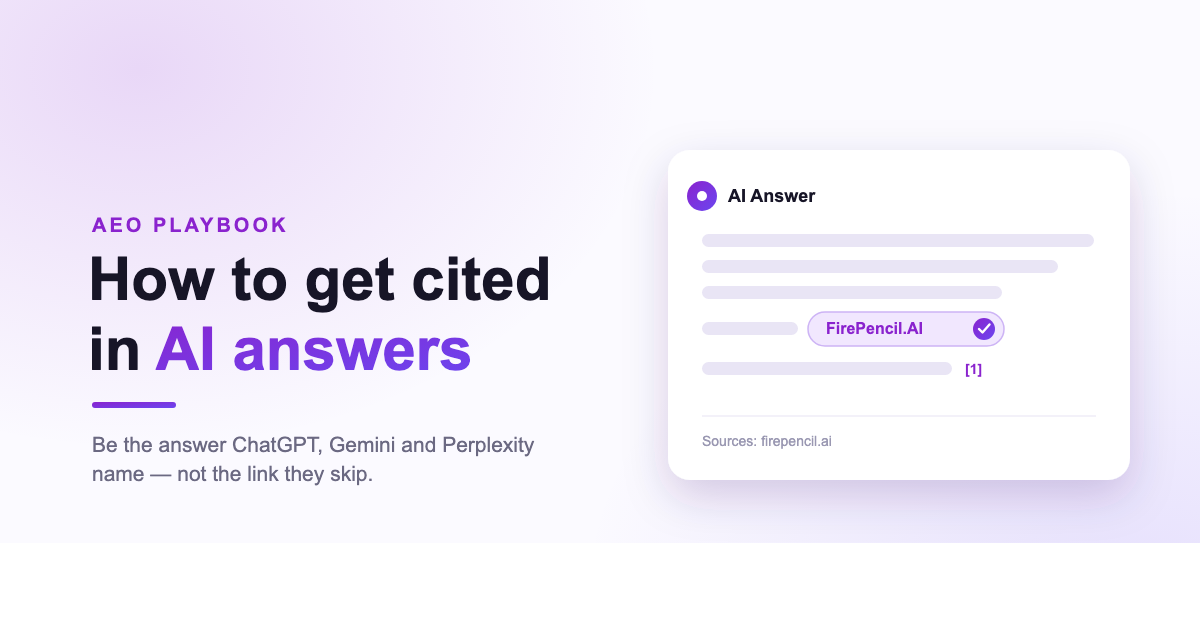
Your customer doesn't open ten blue links anymore. They ask ChatGPT "what's the best moisturizer for oily skin?" and they get one answer, with three brands named in it.
If you're one of those three, you won the sale before your competitor knew the race started. If you're not, you don't exist. There's no page two to scroll to, no "ranking #7 but still getting clicks." In an AI answer, you're either the answer or you're invisible.
This is the new shelf. Here's exactly how to get on it, and how to pick a tool that does it for you.
How AI answer engines decide who gets cited
Answer engines, ChatGPT, Gemini, Perplexity, Claude, Google AI Overviews, don't "rank" you the way Google did. In a fraction of a second they retrieve a few candidate sources, read them, and cite the ones they actually used.
So the whole game is: be a source they can easily retrieve, comfortably read, and confidently trust enough to quote. Strip the jargon and a citable brand has five traits. It's readable, structured, trusted, fresh, and quotable. Everything below is how you earn those five.
The playbook: how to get cited in AI answers
1. Make your site machine-readable
AI doesn't see your beautiful site. It sees raw HTML. If your content is buried under nav bars, pop-ups and JavaScript, the model gives up and grabs a cleaner competitor.
- Let the AI crawlers in. Check
robots.txtactually allows GPTBot, ClaudeBot, PerplexityBot and Google-Extended. Blocking them is the silent killer. You can't be cited if you were never read. - Publish an
llms.txt. A small Markdown file at your root that hands AI a clean, curated map of your key pages. Generate one free in 30 seconds → - Serve clean content. The less noise around your text, the more survives the trip into an AI's context window.
2. Structure content for extraction
AI lifts passages, not pages. The easier a passage is to copy into an answer, the more likely it gets cited.
- Ask the question, then answer it. Use the real question as a heading and give a tight, complete answer in the next two sentences.
- Add schema (structured data).
Organization,Product,FAQPageandHowTomarkup tell engines your facts in a format they can't misread. - Lead with the answer. Conclusion first; storytelling after.
3. Become a coherent entity
AI builds a model of who you are from everywhere you appear. If your site, LinkedIn, a directory and a review site each say something slightly different, the model gets unsure, and uncertain brands don't get cited. State who you are, what you sell and who it's for the same way everywhere. Consistency reads as confidence; confidence reads as citable.
4. Earn trust signals you don't own
A brand only talking about itself isn't trusted; a brand other credible sites talk about is. Get on the review platforms AI quotes for "best X" questions, earn mentions in roundups and communities, and remember that one real review can move you from "not in the data" to "in the data."
5. Stay fresh
AI favors the current. A page last touched in 2021 signals "maybe outdated, skip it." Keep your key pages updated and engines keep trusting you as a live source.
DIY, or use an AEO tool?
You can do all of this by hand, or use a tool to automate it. But "AEO tool," "GEO tool" and "AI SEO tool" cover two very different things, so know what you're buying:
- Trackers / dashboards. Most AI SEO and GEO tools monitor your AI visibility and hand you a to-do list. Useful for measurement, but you still do all the work.
- AEO agents. An AEO agent goes further: it executes the work, llms.txt, schema, entity consistency, citations, continuously, at your server level.
So when you search for the best AEO tool (or the best GEO / AI SEO tool), the real question is: do you want to be told what's wrong, or have it fixed? If it's the latter, an autonomous AEO agent is the strongest pick.
Three mistakes that keep brands invisible
- Blocking the bots by accident. One line in
robots.txtcan make you uncrawlable. Most brands never check. - Writing for humans only. Gorgeous prose with no structure, schema or clear answers, humans love it, machines skip it.
- Treating it as one-and-done. AEO is a system you maintain, not a task you finish. Engines re-crawl and competitors catch up weekly.
Your 10-minute quick-start
- Open
yoursite.com/robots.txtconfirm AI crawlers are allowed. - Generate and publish an
llms.txtat your root. - Add
FAQPageschema to your top 3 pages. - Rewrite one key page question-first, answer-first.
- Make your "who we are" line identical across your site, LinkedIn and one directory.
That won't make you the answer overnight, citation compounds, but it moves you from invisible to in the running, which is most of the battle.
FAQ
What does being cited in AI answers mean?
AEO vs GEO vs AI SEO, what's the difference?
What's the best AEO tool (or AEO agent)?
How do I get cited in AI answers fast?
Is adding an llms.txt file enough?
Does AEO replace SEO?
Want this done for you, automatically?
FirePencil.AI is the autonomous AEO agent that runs this entire playbook at your server level, owner-approved. Start free, or put it on autopilot.