
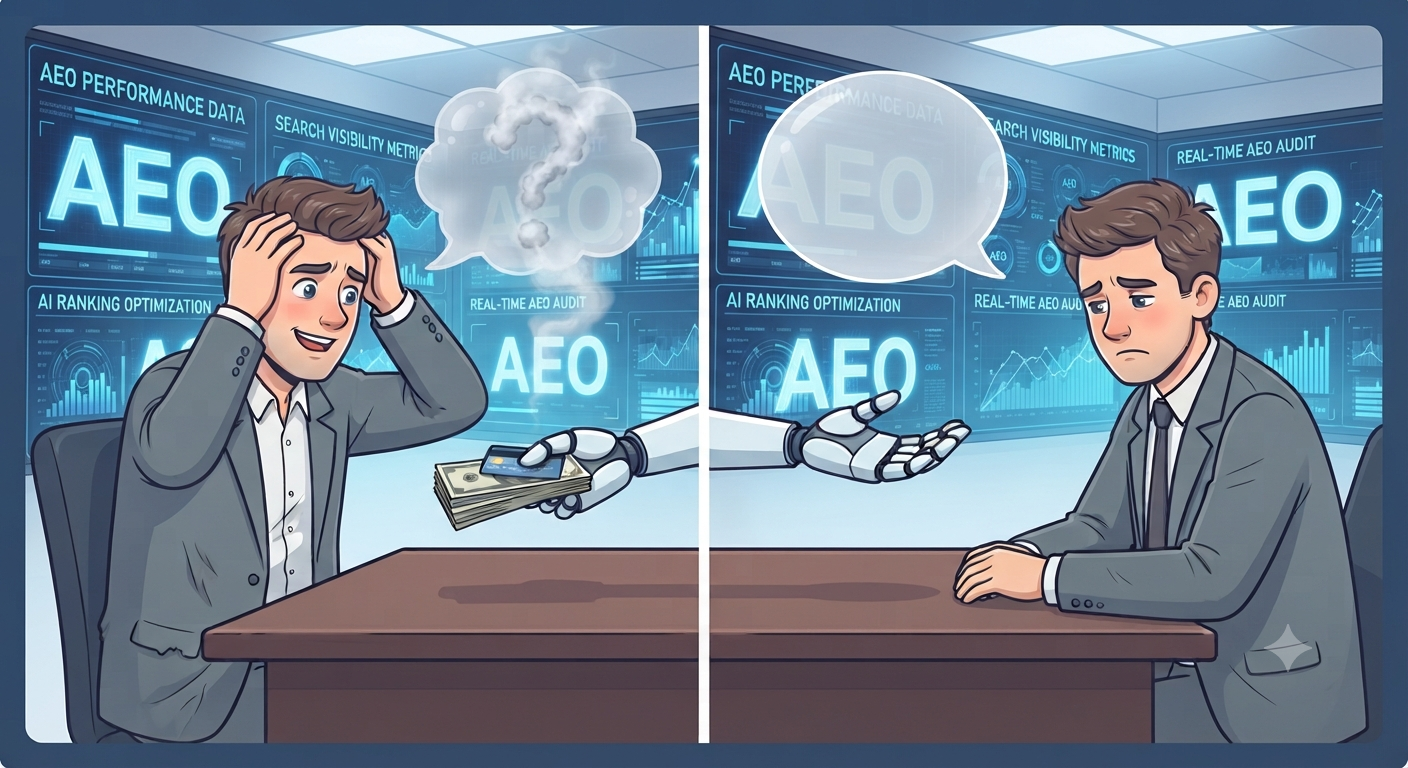
§ What happened to the $4,200?
This week, a pool business owner posted in a large SEO community that he'd spent $4,200 with an agency selling "AEO" and couldn't see what he got for it. The responses piled up fast, and they split into two camps.
Camp one: "AEO doesn't exist. It's a made-up buzzword. Demand a refund." Several practitioners called it SEO malpractice dressed in new vocabulary. One agency owner joked he clearly wasn't charging enough.
Camp two quietly gave better advice: the fundamentals that feed AI answers are checkable, links and authority still matter, and for a local business, being properly indexed and listed where AI engines actually look (including Bing's ecosystem) is table stakes.
Both camps agree on the thing that matters: the owner couldn't verify anything. No baseline, no before/after, no deliverable list. That's the grift signature, and it has nothing to do with whether AI search itself is real.
§ Is AEO a real discipline or a made-up buzzword?
The honest answer: the acronym is new and abused; the shift it describes is not.
Your customers are still asking questions; the answers just stopped routing through your website.
So the question "does AEO exist?" is the wrong question. The right one: is the work you're paying for observable? Real AI-search optimization changes things you can see, pages restructured, listings claimed, citations tracked. Fake AEO changes nothing except the invoice.
§ What does legitimate AI-search work actually include?
Harvested from the practitioners in that thread and validated against how AI engines actually select sources, real work always includes most of these seven deliverables:
- A measured baseline before any work starts. Which questions does your market ask AI engines, and who gets cited today? If nobody recorded where you stood on day one, "progress" can never be shown. This is deliverable zero.
- Bing indexation and health check. Unglamorous, but 87% of ChatGPT Search citations match Bing's top results. If Bing hasn't indexed your pages, ChatGPT largely can't cite you. Any legitimate engagement for a U.S. local business checks this in week one.
- Claimed and completed local listings, including Bing Places. For local queries, AI assistants run live searches and scan the top results. A pool company invisible in Bing's local layer is invisible to the most-used AI assistant. This costs nothing but hours.
- Visible content changes. Question-form headings that match how people actually ask AI ("how much does a fiberglass pool cost in Texas?"), direct answers in the first sentences, clean structure an engine can quote. You should be able to open your own pages and see the difference.
- Third-party presence work. AI engines lean heavily on sources you don't own, review sites, directories, communities, local press. Real practitioners work on getting you mentioned in the places engines already trust, not just on your own domain.
- Citation tracking, not vibes. Monthly reporting should show: these prompts, these engines, you were cited X times vs. Y last month, versus these competitors. First-party data exists now, Bing Webmaster Tools ships an AI Performance report showing how often your site appears in ChatGPT and Copilot answers.
- A connection to business outcomes. Calls, form fills, "how did you hear about us, ChatGPT?" tracking. Citations are the leading indicator; booked jobs are the point.
If your agency's deliverables list doesn't look like this, you're not buying AEO. You're buying a story.
§ What are the red flags of an AEO grift?
Six patterns, straight from this week's thread and a dozen like it:
- Guaranteed rankings in ChatGPT. Nobody controls a probabilistic engine's answers. Guarantees are the oldest tell, recycled from SEO's worst era.
- No baseline measurement. If they didn't measure day zero, they never intended to show progress.
- Secret-sauce language. "Proprietary AEO methods" that can't be described are methods that don't exist.
- Zero visible changes. Months in, your pages look identical and no new listings or mentions exist. $4,200 should leave fingerprints.
- Retainers without deliverables. Every real engagement can list what was shipped this month, in plain language.
- Reports you can't reproduce. If the "visibility score" comes from a tool you can't access or a method they won't explain, it's decoration.
§ How do you verify before you spend?
You can audit any AEO pitch in an afternoon, free: ask ChatGPT, Gemini and Perplexity your customers' ten real questions and record who gets named; check your Bing indexation and claim Bing Places if you're local; open Bing Webmaster Tools' AI Performance report; and demand the seven deliverables above in writing before signing.
- Ask the engines yourself. Open ChatGPT, Gemini, and Perplexity. Ask the ten questions a real customer would ask about your category and city. Note who gets named. That's your baseline, screenshot it.
- Check your Bing indexation (
site:yourdomain.comon Bing) and claim Bing Places if you're local. Free. - Open Bing Webmaster Tools' AI Performance report for first-party citation data. Free.
- Demand the seven deliverables above, in writing, before signing. Any legitimate operator will recognize the list. A grifter will get vague.
The pool company owner's real mistake wasn't believing in AI search. It was paying for something nobody defined and nothing measured.
Verify before you spend. It fits on a sticky note, and it would have saved him $4,200.
Why FirePencil.AI?
FirePencil is the autonomous AEO agent built for exactly this problem: no mystery retainers. It baselines your AI visibility, executes the fixes at your server level (schema, llms.txt, citations, entity coherence), and shows you every change, owner-approved. Verify before you spend: generate your llms.txt free right now, and beta members get a full 12-page reverse-prompt audit across ChatGPT, Gemini, Perplexity and Claude, yours to keep.