
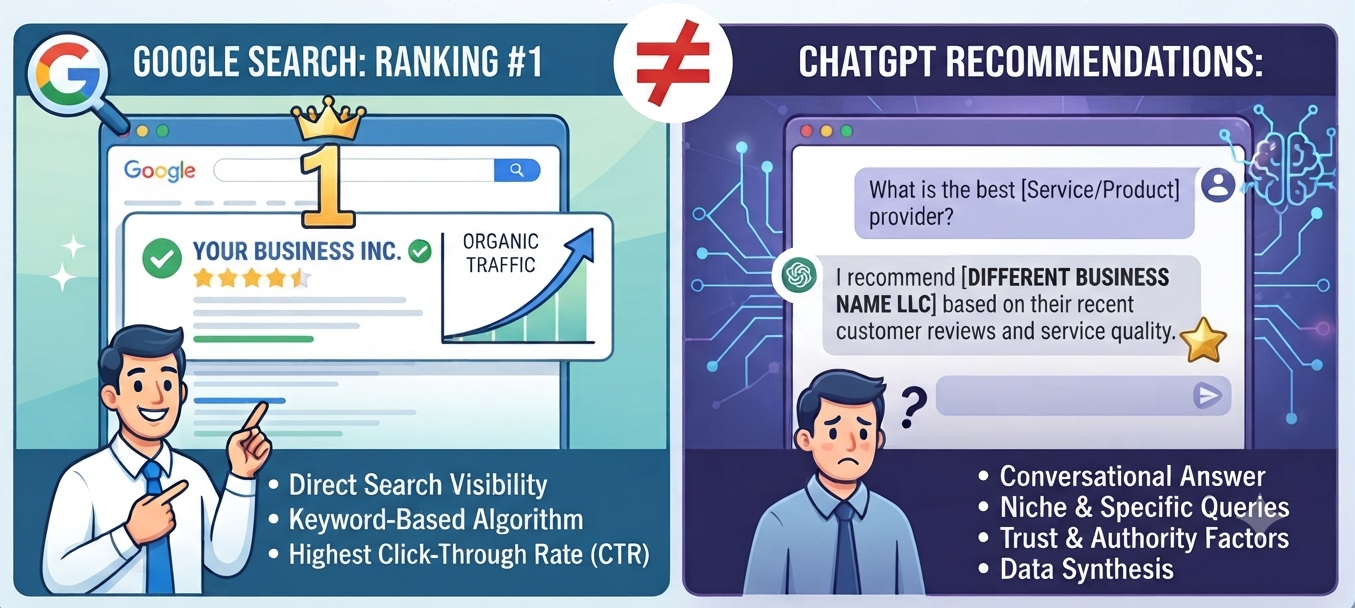
§ How much do Google rankings and AI citations actually overlap?
Far less than most marketers assume, and the gap is widening. A technical SEO community discussion this week put it plainly: practitioners tracking their own sites see #1 Google positions alongside near-zero AI visibility, while "random" sources, forums, review sites, registries, wikis, get cited instead. The data backs them up.
If you've been treating your rank tracker as a proxy for AI visibility, it stopped being one.
§ Why do AI engines ignore top-ranked pages?
Three structural reasons, not one algorithm quirk:
Different index
ChatGPT retrieves through Bing, not Google, 87% of its search citations match Bing's top results. A page that dominates Google but sits unindexed or buried in Bing is invisible to the most-used AI assistant. Your Google rank literally isn't in the room when ChatGPT picks sources.
Query fan-out
AI engines don't search your keyword. They explode the user's question into multiple background sub-queries and assemble an answer from the combined results. A prompt like "best CRM for a small law firm" might fan out into pricing comparisons, integration questions, community threads, and review roundups. You can rank #1 for the head term and appear in none of the sub-queries doing the actual work.
Different source preferences
LLMs over-select content that reads like evidence: community threads, review platforms, wikis, documentation. Reddit alone accounted for over 5% of all ChatGPT citations in January 2026, and citations spread so widely that even the most-cited domain on any platform rarely exceeds 5% of the total, the rest scatter across thousands of sites, most of which no rank tracker watches.
§ Does this mean SEO is wasted effort?
No, and this nuance is where most hot takes get it wrong. Google's AI Overviews still show strong correlation with traditional rankings: 76.1% of cited URLs rank in Google's top 10. Perplexity sits in the middle at ~29% overlap. So your existing SEO keeps paying inside Google's own AI surfaces. It just doesn't transfer to ChatGPT and Gemini, which is exactly where a growing share of high-intent questions now get asked.
| Engine | Overlap with Google top 10 | What it means |
|---|---|---|
| Google AI Overviews | 76.1% | Rankings still largely carry over |
| Perplexity | ~29% | Partial carry-over |
| ChatGPT | 8% | Separate game (Bing index + fan-out) |
| Gemini | 6% | Separate game |
Think of it as three games with one shared foundation: rankings still win AI Overviews, partially win Perplexity, and barely register in ChatGPT and Gemini. You need all three.
§ What actually earns AI citations in 2026?
Six moves, in priority order:
- Get indexed and healthy in Bing. The unglamorous gatekeeper for ChatGPT visibility. Check
site:yourdomain.comon Bing, submit your sitemap in Bing Webmaster Tools, and fix what's missing, then track the free AI Performance report there for first-party citation data. - Cover the fan-out, not just the head term. Map the sub-questions inside your money queries, costs, comparisons, "is X worth it," how-tos, and answer each on its own extractable page or section. Fan-out sub-queries are the new keyword research.
- Structure for extraction. Question-form headings, a direct answer in the first two sentences of each section, tables and lists where data lives. An engine assembling an answer quotes the page that already looks like one.
- Build third-party presence. Reviews, directories, community threads, YouTube, the sources engines treat as evidence. Most AI citations point at pages about you that you don't own. Earning mentions there is now visibility work, not PR vanity.
- Stay fresh. Recently updated content is disproportionately cited. Refreshing your key pages quarterly, with visible updated dates, beats publishing new ones into the void.
- Keep your entity consistent. Same business name, offer, and facts across your site, listings, and profiles. Engines cross-check; contradictions cost citations.
§ How do you check where you stand right now?
Ask the engines the ten questions your customers actually ask, in ChatGPT, Gemini, and Perplexity, and record who gets named. Check your Bing indexation. Open Bing Webmaster Tools' AI Performance report. That's a free day-zero baseline.
- Ask ChatGPT, Gemini, and Perplexity your ten real customer questions; screenshot who gets named. That's your baseline.
- Check Bing indexation (
site:yourdomain.comon Bing) and submit your sitemap. Free. - Open Bing Webmaster Tools' AI Performance report for first-party ChatGPT/Copilot citation data. Free.
- Compare against competitorsnote which sources the engines cite instead of you. Those are your target placements.
The uncomfortable truth from this week's practitioner discussion is also the opportunity:
Since more than 80% of AI citations go to pages that don't rank, the citation game is still wide open, including for businesses that never won the ranking game.
Why FirePencil.AI?
Your rank tracker can't see AI answers, FirePencil can. The autonomous AEO agent baselines which questions your market asks ChatGPT, Gemini, Perplexity and Claude, shows who gets cited instead of you, then executes the six moves above at your server level, schema, llms.txt, structure, entity coherence, owner-approved. Start free: generate your llms.txt in seconds, and beta members get a 12-page reverse-prompt audit across all four engines.