
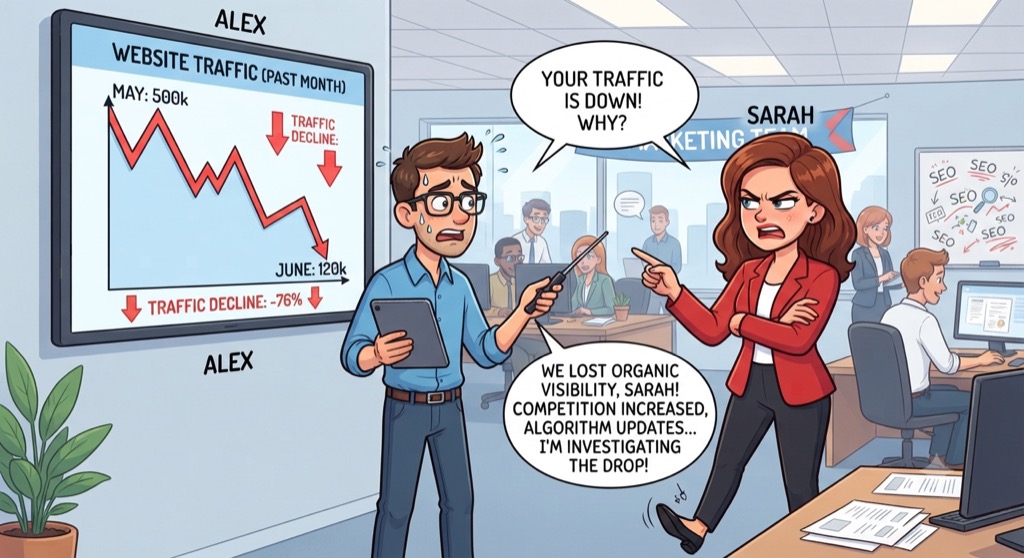
§ The Monday-morning problem
Somewhere this week, a marketing manager is walking into a review meeting with a traffic chart that points down and no confident answer to the only question that matters: is marketing failing, or is the metric?
The stakes of getting that answer wrong run in both directions. Judge a working strategy by a dying metric and you'll fire the wrong people and fund the wrong fixes. Excuse a failing strategy with "traffic doesn't matter anymore" and you'll bleed for two quarters before anyone notices. So it's worth knowing what the people who study this hardest actually think, because they disagree, informatively.
§ The debate: three positions worth taking seriously
Rand Fishkin The click is dying
SparkToro's 2026 clickstream research found 68% of US Google searches end without any click; of every 1,000 searches, only 276 reach the open web, down 26% in two years. His prescription is "zero-click marketing": influence buyers on the surfaces where they already are (AI answers, social, communities) and stop measuring success purely by visits you'll never get back.
Eli Schwartz Don't panic
Working from 260-billion-session clickstream data, Schwartz's counters are sharp: total search volume is up roughly 26% since ChatGPT launched; users run Google and AI in parallel rather than replacing one with the other; and traffic loss concentrates in informational queries, while commercial-intent clicks are far more resilient. His line: "the data doesn't support extreme measures." Shift toward bottom-funnel and product-led work, yes; burn the traffic dashboard, no.
Cyrus Shepard It's the business model
Shepard studied 400+ sites that survived the 2024–26 declines and found survival wasn't predicted by tactical excellence at all, but by structural traits: strong brand, task completion, proprietary data. His uncomfortable summary: "no amount of tactical excellence can save you if your business model is wrong." Sites whose entire value was answering informational questions are the ones AI answers replace.
Three smart people, three positions. Then the tiebreaker landed.
§ The tiebreaker: the first randomized experiment
Nearly every traffic study until this year was observational, correlation confounded by seasonality and algorithm updates. In June, researchers from ISB and Carnegie Mellon published the first randomized controlled experiment: 1,065 real users, AI Overviews experimentally toggled.
That last number quietly demolishes the comforting story that lost clicks are just "answered better." Users weren't happier; they just didn't click. The clicks aren't being replaced by satisfaction. They're being absorbed by the interface.
And on the buyer side, the shift is already behavioral, not predicted: Semrush's 2026 study of B2B buyers found 89% expect to rely more on AI for purchase research, with roughly seven in ten using AI tools daily, building shortlists inside the AI conversation before any website visit. By the time your analytics sees a visitor, much of the decision already happened somewhere your dashboard can't see.
§ The verdict: traffic was demoted, not deleted
Put the three positions and the experiment together and the synthesis is surprisingly clean:
- Schwartz is right that commercial-intent traffic still matters. Track it, defend it, attribute revenue to it.
- Fishkin is right that the top of your funnel has left your website, and needs to be measured where it now lives.
- Shepard is right that this is a business-model question: if all your value was informational visits, no KPI change saves you.
- The experiment proves the clicks aren't coming back and aren't being "quality-filtered". The interface simply keeps them.
Traffic didn't die. It stopped being the verdict on marketing and became one symptom among several.
A business measuring only visits in 2026 is reading yesterday's scoreboard: accurately, and irrelevantly.
§ The replacement KPI stack
What to measure instead, five metrics, all practical today:
- Citation frequency on your prompt sethow often AI engines name you on your buyers' 10–25 real questions, measured with repeated runs against your own baseline (the honest method).
- Branded search volumepeople who saw you in an answer and later searched your name. The classic proxy for invisible influence, newly relevant.
- Direct-traffic trendsame logic: influenced buyers skip the funnel and type your URL.
- The intake tallyone question added to every form and call: "How did you hear about us?" Count the answers that say ChatGPT, Gemini, or "an AI." Crude, honest, and connects visibility to revenue better than any dashboard.
- Pipeline-source mixthe share of closed business that began with an AI-era signal (branded search, direct, AI-referred) versus classic organic clicks. That ratio is your personal version of this whole debate, updated monthly.
Keep from the old world: traffic and conversion on commercial-intent pages. Retire: celebrating informational-page traffic as a success metric. That's the traffic AI absorbed first, and it isn't coming back.
See where you stand before the next review meeting
FirePencil is built for the demoted-traffic era: its agent tracks your citation frequency across ChatGPT, Gemini, Perplexity and AI Overviews the honest way, repeated runs, trendlines, receipts, then executes the work that moves those numbers, weekly and owner-approved, with your SEO foundations maintained in the same system.
§ Frequently asked questions
Is website traffic still a valid KPI in 2026?
How much do AI Overviews reduce clicks?
What is zero-click search?
What should replace website traffic as a KPI?
Do B2B buyers still visit websites before choosing a vendor?
FirePencil.AI is an autonomous AEO agent. This article summarizes third-party research and public commentary (SparkToro, Semrush, and the cited ISB/Carnegie Mellon experiment) for general information; figures are as reported by those sources. It is not a guarantee of any specific result. Third-party names (ChatGPT, Gemini, Perplexity, Claude, Google AI Overviews) are trademarks of their respective owners; use is descriptive.